Voices For Justice: Rallying For Decent Work At Kampala’s Labour Day Celebration
Voices For Justice: Rallying For Decent Work At Kampala’s Labour Day Celebration
Voices For Justice: Rallying For Decent Work At Kampala’s Labour Day Celebration
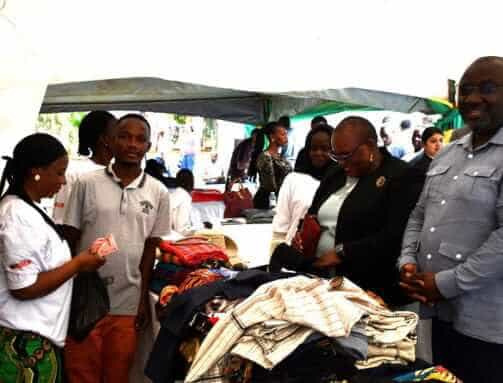
May 30, 2025, Justice Linda Mugisha Tumusiime (2nd Right), flanked by KCCA Deputy Executive Director Kigenyi Benon Moses (Right), buys a kitenge material from a Re:BUiLD client during Labour Day Celebrations at KCCA Grounds in Kampala (PHOTO: Edna Karyne Kyokunzire for The IRC)
“Let us empower workers, especially the youth, women and with knowledge about their rights at work. One particular and special group of people, the refugees, are either unaware of their right to work or unable to access services that support this right. This is evident in the fact that, since the establishment of the Industrial Court in 2006, only two cases involving refugees have been registered,” said Justice Linda Mugisha Tumusiime, Head judge of the Industrial Court of Uganda and the Chief Guest While speaking at the Kampala Capital City Authority Labour Day Celebrations at City Hall Gardens in Kampala on May 30, 2025.
In a country that hosts one of the largest refugee populations in Africa (1,927, 593 as of June 30, UNHCR), such statistics are not only revealing but deeply concerning. It exposes a gaping disconnect between existing legal protections and the actual experiences of refugee workers on the ground.
Justice Tumusiime also called on stakeholders, government bodies, employers, labour unions, NGOs, and civil society to uphold the principles of decent work. She emphasized that decent work is not merely a slogan but a fundamental human right, grounded in four key pillars: employment creation, social protection, rights at work, and social dialogue.
This year’s event wasn’t just about traditional tributes to workers; it was a bold demand for fairness, dignity, and accountability in the workplace especially for the most vulnerable members of Uganda’s labour force: women, youth, and refugees.
Refugees: Invisible Hands in the Urban Workforce
Raphael Okoropot, the Kampala Field Manager for the International Rescue Committee (IRC) highlighted persistent challenges that refugee workers face:
Documentation issues that complicate access to employment.
Language barriers that isolate refugees in the workplace.
Non-recognition of foreign qualifications, reducing professionals to menial jobs.
Widespread labour disparities that create a quiet but dangerous inequality between nationals and refugees.
“We must create an inclusive urban environment,” Okoropot emphasized. “That means streamlining work permits, recognizing foreign skills and credentials, and sensitizing employers to the rights of refugee workers.”
Way Forward: Turning Words into Action
This year’s Labour Day in Kampala was a moment to call for action to ignite real change through the following steps:
Strengthening legal awareness campaigns targeting youth, women, and refugee populations about their rights at work.
Improving access to justice by making legal processes more refugee-friendly, including the use of interpreters and mobile legal clinics.
Reforming work permit processes to make them affordable, transparent, and accessible to refugees and migrants.
Recognizing and validate foreign qualifications, allowing skilled refugees to contribute meaningfully to Uganda’s economy.
Enforcing labour laws to ensure employers are held accountable to fair wages, safe workplaces, and non-discriminatory hiring.