From 2021 to 2025, Re:BUiLD generated rigorous evidence through pilots, randomized controlled trials (RCTs), monitoring data, and mixed-methods research to identify what works, and what doesn't, improving urban refugee livelihoods.
 |
 |
 |
Randomized Controlled Trials (RCTs)
The RCTs were a core component of Re:BUiLD’s Evidence & Learning Strategy. Through the RCTs, Re:BUiLD rigorously tested which livelihoods interventions, delivery models, and social cohesion approaches produced the strongest and most cost-effective outcomes for urban refugees and host community members. The trials aimed to answer three central questions:
-
Which interventions work better for refugees and host community members?
-
How do different delivery models affect economic outcomes? What role do social and business networks play in advancing livelihoods?
-
How do livelihoods programs influence social cohesion between groups?
Findings from the trials directly shaped the program design and fed into Re:BUiLD’s broader policy influence agenda.
Re:BUiLD implemented multiple RCTs across Kampala and Nairobi, making it one of the most significant urban refugee livelihoods research efforts in East Africa.
Wave 1 RCTs (Completed)
The studies were registered with the American Economic Association's (AEA) registry for RCTs (Kenya and Uganda), and the initial findings were launched at the Re:BUiLD Research & Policy Symposium, 2024. A qualitative study unpacking the effects of mentorship was carried out following the Wave 1 RCTs, exploring how mentorship mechanisms operate across client groups.
Both RCTs in Kampala and Nairobi, serving 4,000 participants (2,000 in each city), looked at one common dimension of livelihood programs supporting microentrepreneurs: mentorship services, where the mentors were microentrepreneurs themselves. Administered from the IRC’s Livelihood Centers in each capital, the studies informed IRC’s programming around the world as well as many other policy organizations looking to improve microentrepreneurs' livelihoods in urban settings.
Key Lessons from Wave 1
-
Cash Grants Reliably Boost Business, but Mentorship Impact Varies by Context
The results indicate that combining cash grants with targeted mentorship may improve business outcomes compared to cash alone, although effects vary by context and baseline client capacity.
-
Segmented Approaches are Essential
Evidence suggests that refugees and host community members respond differently to interventions, reinforcing the need for tailored programming.
-
Social Cohesion Interventions Are Viable
Structured contact between refugees and hosts shows potential to reduce discrimination and improve trust and economic collaboration.
-
Mixed-methods Strengthen Understanding
Qualitative studies clarified mechanisms behind observed impacts, especially in mentorship.
-
Evidence is Driving Policy Conversations
Re:BUiLD’s RCT findings have informed discussions at regional bodies, government forums, and multi-stakeholder convenings, including the Research & Policy Symposium.
-
Challenges & Mitigation
Common challenges include managing large-scale recruitment, ensuring operational consistency and maintaining ethical integrity when serving vulnerable populations
The Uganda working paper and the policy briefs can be accessed here (Kenya and Uganda).
Dissemination
The results have so far been presented at the Annual Bank Conference on Development Economics 2024, Joint Data Center Research Conference on Forced Displacement 2024 and IPA/DLI webinar.
The RCTs were conducted in partnership with Center for Global Development, (CGD), Innovation for Poverty Action’s Displaced Livelihoods Initiative (DLI), Rochester University (RU), Princeton University (PU), Georgetown University and the Economic Policy Research Center (EPRC).
Wave 2 RCTs (Ongoing)
The study is registered with the American Economic Association's (AEA) registry for Randomized Controlled Trials.
What Wave 2 Is Testing
The evidence from Wave 1 showed that capital constraints alone are not the only barrier, lack of social networks is one of the most significant obstacles to starting and sustaining microenterprises. Wave 2 has therefore been designed to understand which types of networks, and which ways of building them, generate meaningful economic and social gains.
Wave 2 is testing whether strengthening social and business networks can improve the livelihoods of refugee and host community entrepreneurs in Kampala and Nairobi. The study is comparing different ways of helping entrepreneurs connect with one another, such as small peer groups and larger business meetups, to see which approaches lead to stronger networks, better access to information, and improved business outcomes. The goal is to understand how building both closeknit and broader professional connections can support business creation, profitability, social cohesion, and overall self-reliance.
Outcomes Being Measured
For whom are these interventions most impactful? Wave 2 is measuring a combination of economic, social, and wellbeing outcomes to understand how different networking approaches affect refugee and host entrepreneurs. The study is tracking whether participants are more likely to start or sustain businesses, improve profits, strengthen market linkages, and make productive use of business grants, early data shows that over half of Wave 2 businesses were launched after receiving grants. It also assesses social cohesion, including trust, collaboration, and the formation of both strong and weak business ties between refugees and hosts. Finally, the trial measures psychological wellbeing and selfreliance, examining whether stronger networks contribute to reduced stress, increased confidence, and greater economic independence.
Why Wave 2 Matters
Urban markets in Kampala and Nairobi rely heavily on interpersonal networks, trust, referrals, and informal systems. Refugees often enter these markets at a disadvantage due to exclusion from such networks. Wave 2 aims to determine which types of networking interventions can structurally reduce this disadvantage and enable equitable economic integration.
The RCT is being conducted in partnership with Stanford University Immigration Policy Lab, Georgetown University, Makerere University and IPA serving 8,000 participants (4,000 per city).
Progress to date
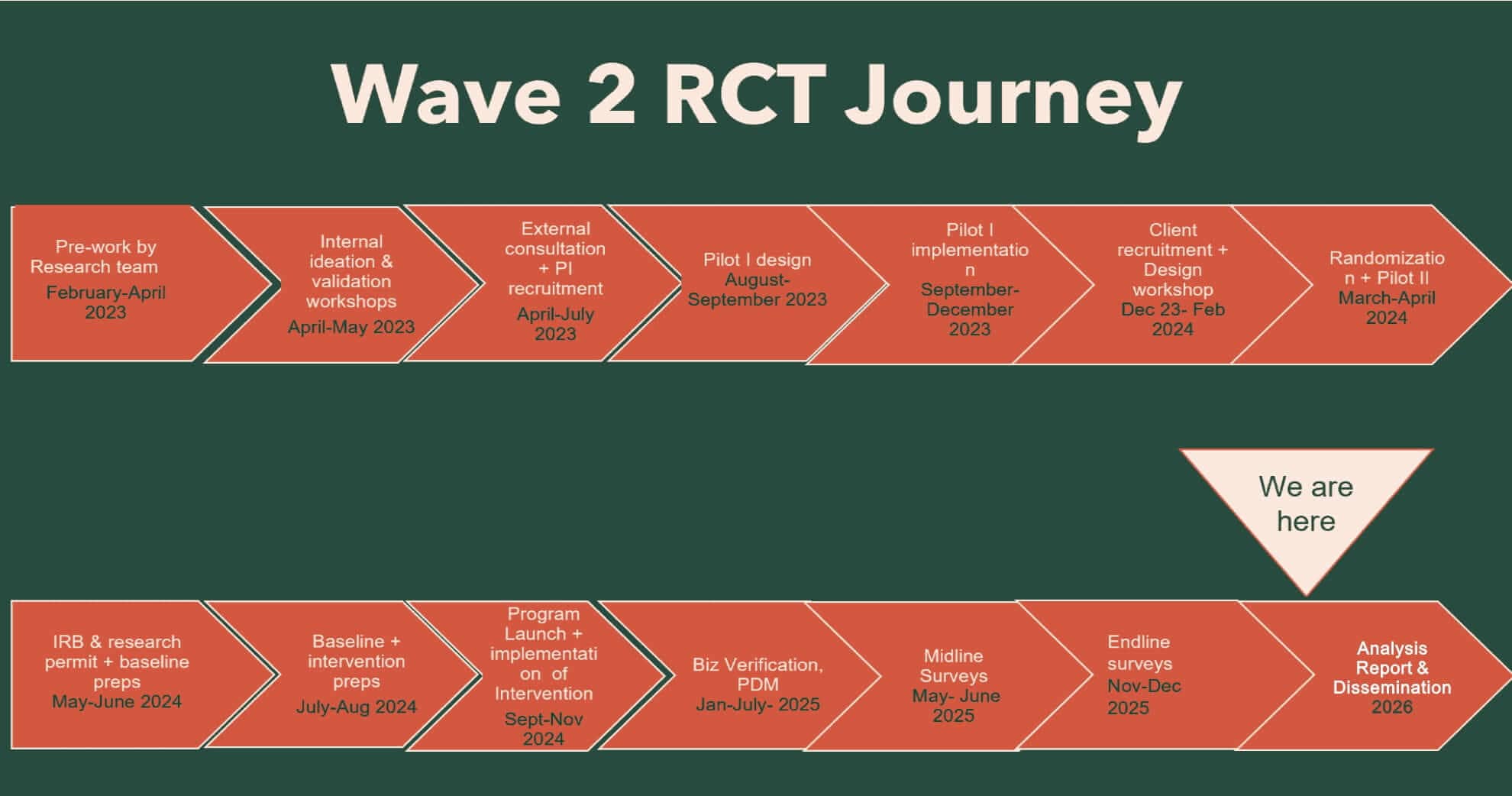
Upcoming and Planned Research Activities (2026–2027)
-
Publication of full Wave 1 RCT academic papers (links to be updated as they go live).
-
Wave 2 analysis and dissemination through conferences, webinars and symposia.