New Evidence Proves Urban Refugees Are Bankable
New Evidence Proves Urban Refugees Are Bankable
New Evidence Proves Urban Refugees Are Bankable
By Nathan Tibaku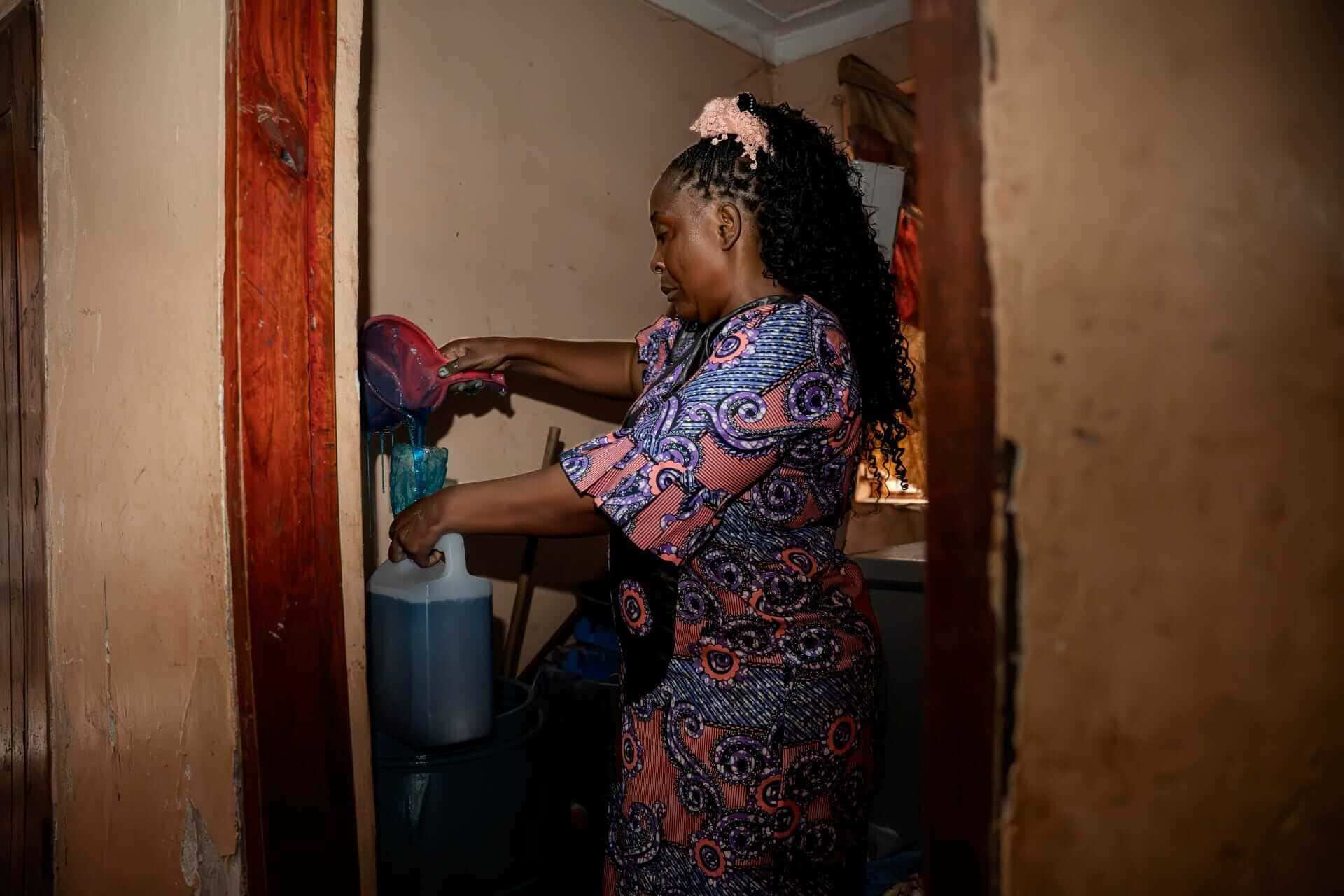
May 21, 2025, Kampala, Uganda. Abigail Mangaza, packaging liquid soap at her premises in Kampala. Accesing loans at UGAFODE has helped her start the business. (PHOTO: Nathan Ijjo Tibaku for The IRC)
As donor funding for refugee support continues to decline, new evidence from the International Rescue Committee’s Re:BUiLD program presents a compelling alternative: empowering refugees through inclusive financial systems. A pilot linking urban refugees and host community members in Kampala to UGAFODE Microfinance Limited through a Results-Based Loan Guarantee Fund has demonstrated that refugees are not only creditworthy but also capable of growing sustainable businesses.
Between July 2023 and March 2025, 129 clients accessed UGX 194.8 million in loans. Of these, 69 percent repaid both principal and interest, proving their reliability. Encouraged by this success, UGAFODE extended UGX 189.9 million of its own funds to 148 clients after the pilot ended. A total of 245 clients opened accounts, with many choosing to save rather than borrow, reflecting growing trust in formal financial services.
Florence Mutonerwa, Head of Product Development and Research at UGAFODE, emphasized the significance of this shift: “The urban refugee is a bankable refugee because there are so many who have succeeded. If a refugee borrows, uses the money, and comes back for more, I know I have created an impact on their household.”
That impact is evident in the stories of Re:BUiLD clients like Apoyo Zabibu Furaha, who runs a grocery shop in Kampala. “Truly, the loan is improving my business. I had no money for a fridge, but UGAFODE helped me without a struggle. Now I make juice, store yoghurt, and my business is growing. My family is safe,” she shared.
Abigail Mangaza, another client, used her third loan of UGX 1 million to start a liquid soap business. Her repayment commitment is strong: “I am supposed to pay UGX 200,000 monthly, but I want to pay UGX 400,000 to finish in three months.”
Women made up 70 percent of clients, and 78 percent were refugees, highlighting the need for genderresponsive financial products. However, challenges remain. Many clients found UGAFODE’s interest rate of approximately 17.9 percent per annum to be significantly higher than the 10 percent typically charged by community-based Urban Savings and Loans Associations. This discouraged some from borrowing, even after opening accounts.
Structural barriers such as a lack of documentation and legal identification also continue to limit access to financial services for many urban refugees. Moses Odokonyero, the Senior Program Manager at Re:BUiLD Uganda emphasized that “These issues must be tackled collaboratively by financial institutions, government agencies, and humanitarian actors to unlock the full economic potential of refugee communities.”
Formalizing savings groups as Community-Based Organizations and recruiting refugee staff improved access and trust. The Re:BUiLD program urges financial institutions to design refugee-friendly products, clarify loan terms, and collaborate to share evidence and influence policy.